


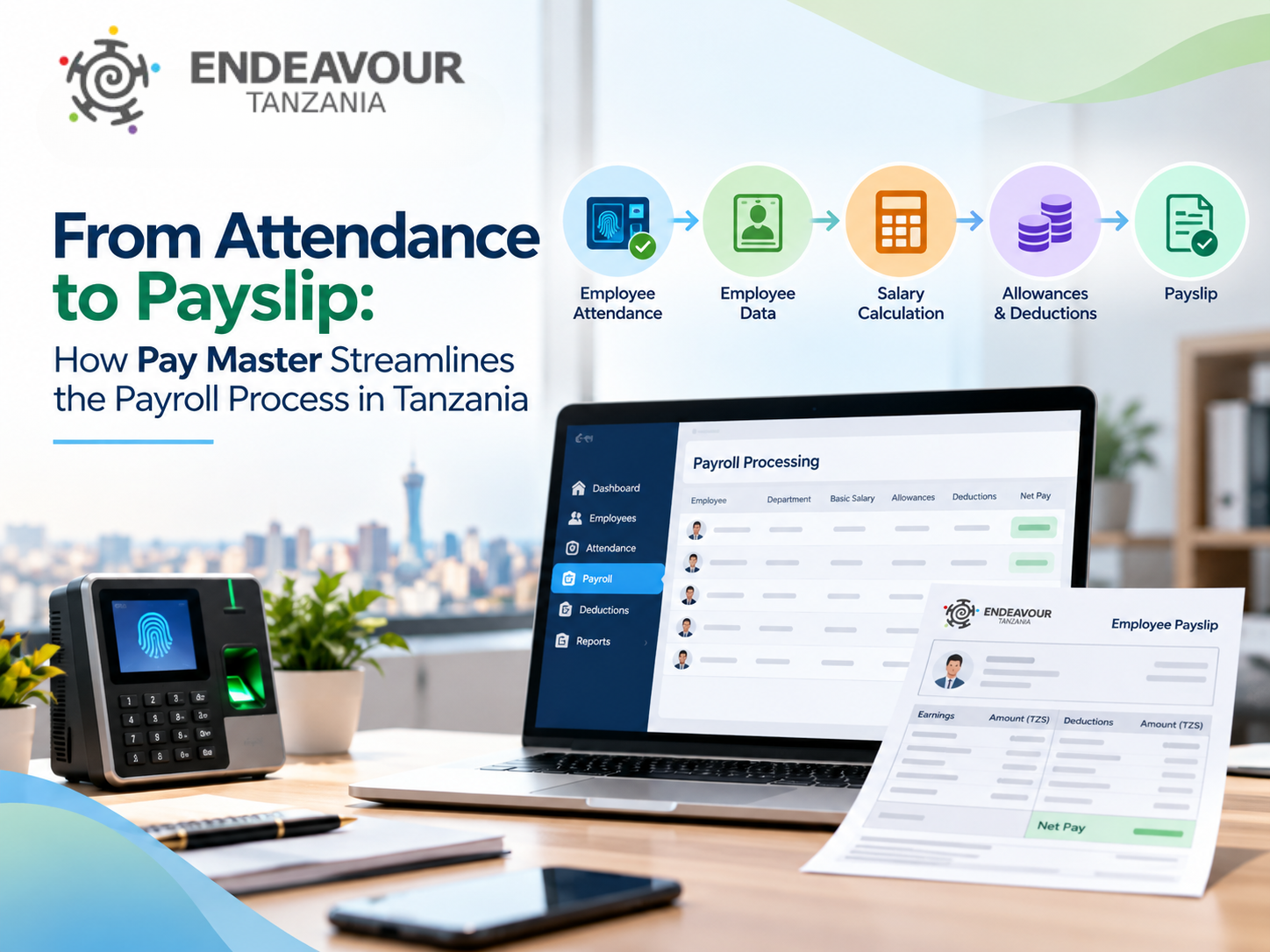
Payroll is one of the most important administrative processes in any business. Every month, HR and finance teams need to collect employee attendance information, calculate working hours, consider overtime and allowances, apply deductions, process salaries, and provide accurate payslips. When these activities are handled manually, even a small error can create additional work and affect employee confidence.
For businesses in Tanzania with growing workforces, payroll can become even more complex when employees work different shifts, have different salary structures, receive allowances, or work across multiple departments and locations.
Pay Master Software provides a structured approach to payroll processing by connecting employee information with payroll calculations and related attendance data. When Pay Master works alongside TA Master and other EnQuest HCM components, businesses can create a more connected process that starts with employee attendance and ends with an accurate payslip.
Why Payroll Starts with Accurate Attendance Data
Payroll processing does not begin when salaries are calculated. It begins with reliable employee information and attendance records.
Working days, hours worked, overtime, absences and other attendance-related information can affect an employee’s final payroll. If HR teams have to collect this information manually from attendance registers, spreadsheets or separate systems, preparing payroll can take considerable time.
Manual attendance records can also create challenges when HR needs to verify whether an employee arrived on time, worked additional hours, or was absent on a particular day.
With TA Master, businesses can capture attendance information using configured attendance methods such as biometric devices and other supported attendance options. The resulting attendance information can then support the payroll process in Pay Master.
This creates a more structured connection between actual attendance and payroll preparation.
Connecting Attendance with Payroll
One of the biggest advantages of connecting attendance and payroll is reducing the need for repeated manual data entry.
Instead of HR teams calculating attendance-related information separately and then entering figures into payroll, attendance data can form part of the connected payroll workflow.
For example, where overtime is applicable according to an organization’s policies, attendance information can help identify the relevant working hours. HR can then review the information before payroll processing.
This approach helps create a clearer relationship between what happened during the working period and what is reflected in the employee’s salary calculation.
For businesses managing many employees, this connection can significantly simplify monthly payroll administration.
Employee Information in One Payroll Process
Accurate payroll depends on accurate employee information. Employee salary details, departments, employment information and other relevant payroll records need to be maintained consistently.
Pay Master provides a centralized environment for managing payroll information, helping HR and finance teams work with organized employee records rather than maintaining multiple disconnected payroll files.
When employee information changes, such as salary components or applicable deductions, the payroll team can update the relevant information within the system rather than repeatedly modifying separate spreadsheets.
This becomes increasingly valuable as a company grows and the number of employees and payroll transactions increases.
Managing Salary Components, Allowances and Deductions
Employees do not always have identical salary structures.
Depending on the organization and employee role, payroll may include different salary components, allowances, deductions, overtime or other adjustments. Managing these calculations manually can increase the workload for payroll teams.
Pay Master helps businesses structure these payroll components within the payroll process. Instead of relying on manually maintained calculation sheets for every employee, payroll teams can process salary information through a centralized system.
This provides a more consistent approach to payroll preparation and makes it easier for authorized users to review payroll information before final processing.
The objective is not simply to calculate salaries faster. It is to create a more organized payroll workflow where employee information and salary components are easier to manage.
Reducing Repetitive Payroll Work
Monthly payroll often involves many repetitive activities.
HR teams may need to collect attendance information, check employee records, calculate overtime, review deductions, prepare salary calculations, generate payslips and maintain payroll reports. Repeating these activities manually every month takes time that could otherwise be used for more valuable HR work.
Pay Master helps automate and organize several parts of this process.
By maintaining payroll information in a centralized system, payroll teams can reduce repeated spreadsheet calculations and manual data handling. This can make the payroll cycle more structured and easier to manage.
For growing businesses, reducing repetitive administration can also help HR teams spend more time on employee management and workforce planning.
From Payroll Calculation to Payslip
The final stage of payroll processing is communicating salary information to employees.
Employees generally want clear information about their salary, allowances, deductions and final payable amount. Preparing payslips manually for a large workforce can therefore become another administrative task.
Pay Master supports the generation and management of employee payslips as part of the payroll process. This gives businesses a more organized way to provide payroll information while maintaining corresponding payroll records.
A structured payslip process can also make it easier for HR teams to respond when employees have questions about their salary information.
A Connected Payroll Workflow with EnQuest HCM
Payroll does not operate independently from HR.
Employee records, attendance, leave, payroll and other workforce information are closely connected. When these areas are managed through disconnected systems, HR teams may need to transfer information manually between different platforms.
With EnQuest HCM, businesses can connect key workforce processes, while Pay Master focuses on payroll management and TA Master supports time and attendance.
This creates a workflow where employee information can support attendance management, attendance information can contribute to payroll processing, and payroll can result in organized salary records and payslips.
For HR and finance teams, having connected information can make the overall process easier to manage.
Improving Payroll Visibility for Management
Payroll is also an important source of business information.
Management may need to understand overall payroll costs, salary structures, overtime and other payroll-related information. When payroll records are maintained across spreadsheets and manual files, generating useful reports can take additional time.
A centralized payroll system can provide better visibility into payroll information and support reporting for HR and management.
This helps businesses move beyond simply processing salaries each month. Payroll data can also contribute to broader workforce and cost management decisions.
Why an Integrated Approach Matters for Growing Businesses
A small business may initially manage payroll using spreadsheets or manual processes. As the workforce grows, however, the same approach can become increasingly difficult to maintain.
More employees mean more attendance records, more salary calculations, more deductions, more payslips and more opportunities for data-entry mistakes.
An integrated approach using TA Master, Pay Master and EnQuest HCM can help businesses create a more structured workforce management process.
From recording attendance to processing payroll and generating payslips, each stage can be connected rather than treated as a completely separate activity.
For Tanzanian businesses looking to improve their payroll operations, this can provide a practical way to reduce administrative workload while improving visibility and organization.
How EndeavourTanzania Helps Businesses Simplify Payroll Management
For businesses in Tanzania looking to improve their payroll processes, EndeavourTanzania provides payroll and workforce management solutions designed to bring greater structure to everyday HR operations. Through Pay Master, businesses can manage key payroll activities including employee salary processing, allowances, deductions, payroll records and payslips.
Pay Master can also work alongside TA Master for attendance management, creating a connected workflow from employee attendance through payroll processing. This helps HR and finance teams reduce repetitive manual work and maintain payroll information in a more organized system.
For businesses with growing workforces, having payroll and attendance processes connected can make it easier to manage monthly payroll while giving HR teams better visibility over employee and salary information.
Why Choose EndeavourTanzania for Pay Master?
EndeavourTanzania understands the operational needs of businesses working in the Tanzanian market. Its software solutions are designed to help organizations manage important business processes through structured and integrated systems.
With Pay Master, businesses can move away from heavily manual payroll processes and create a more organized approach to managing employee salaries, payroll calculations and payslips. Combined with other EnQuest HCM solutions, businesses can build a connected HR workflow covering employee information, attendance and payroll.
Conclusion
Payroll is more than simply calculating an employee’s monthly salary. It involves a chain of information that begins with employee records and attendance and continues through working hours, overtime, allowances, deductions, salary calculations and payslips.
Pay Master Software in Tanzania helps businesses bring this process into a more organized payroll environment. When connected with TA Master and EnQuest HCM, businesses can create a smoother flow of information from attendance to payroll and ultimately to the employee payslip.
For growing organizations, this connected approach can reduce repetitive manual work, improve payroll visibility and make monthly payroll processing easier to manage.
Frequently Asked Questions
What is Pay Master Software?
Pay Master is a payroll management solution designed to help businesses manage employee salary processing, payroll information, deductions, allowances and payslips.
How does attendance data support payroll processing?
Attendance information can provide working-time and overtime data that may be relevant to payroll calculations, depending on the organization’s payroll policies and configuration.
Can Pay Master work with TA Master?
Yes. Pay Master can be used alongside TA Master to create a connected attendance-to-payroll workflow.
Does Pay Master generate employee payslips?
Yes, Pay Master supports employee payslip generation as part of the payroll process.
Why connect HR, attendance and payroll?
Connecting these processes reduces repeated data entry and creates a more consistent flow of employee information from attendance management through payroll processing.
