


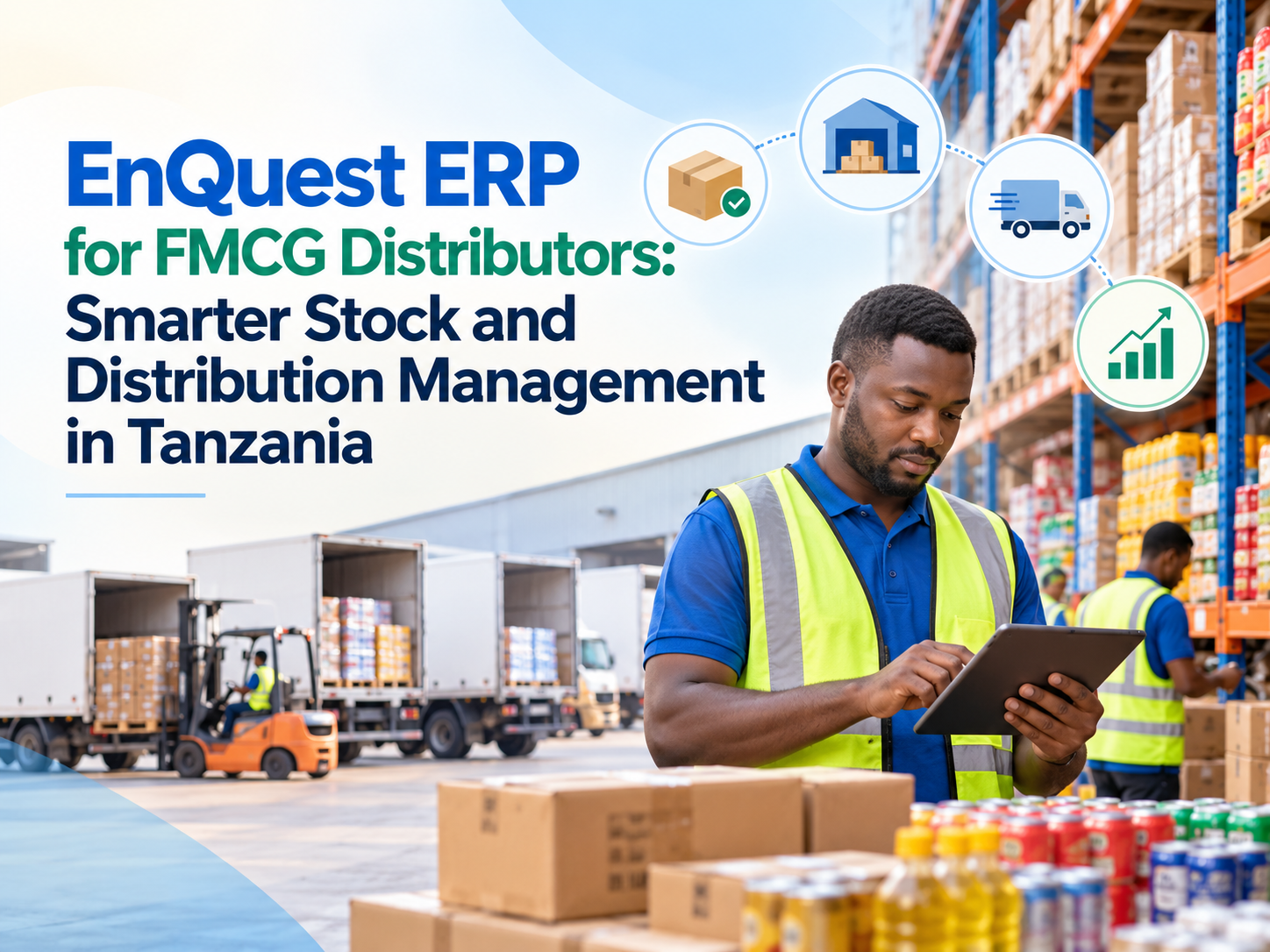
The FMCG industry moves quickly. Products need to reach customers on time, inventory changes every day, sales orders come from different locations, and distributors must constantly balance stock availability with customer demand. For FMCG distributors in Tanzania, managing all these activities manually or through disconnected systems can become increasingly difficult as the business grows.
A distributor may have stock in multiple warehouses, hundreds or thousands of products, different suppliers, many customers, and sales teams handling orders across different territories. When inventory, purchasing, sales, finance, and distribution information are managed separately, it becomes harder to understand what is actually happening across the business.
This is where EnQuest ERP can provide a more connected approach. By bringing important business operations into one system, ERP software helps FMCG distributors gain better visibility over stock, sales, purchasing, warehouse activities, and financial information.
Why Stock Management Is a Major Challenge for FMCG Distributors
Stock is at the center of an FMCG distribution business. Having too little inventory can lead to missed orders, while holding excessive inventory can tie up working capital and increase the risk of slow-moving stock.
The challenge becomes greater when a distributor operates multiple warehouses or branches. Management needs to know what products are available, where they are located, what has already been sold, what is waiting to be received from suppliers, and which products may need replenishment.
When this information is maintained in spreadsheets or separate systems, teams may work with outdated data. Sales staff might accept an order without having a clear picture of current stock availability. Purchasing teams may order products that are already sufficiently stocked elsewhere. Management may only discover these problems when reports are manually prepared.
EnQuest ERP helps centralize this information so that inventory movements are connected with other business activities.
Better Inventory Visibility with EnQuest ERP
For FMCG distributors, inventory visibility is not simply about knowing the total quantity of a product. Businesses also need to understand where stock is located and how inventory is moving.
With a centralized ERP system, warehouse transactions can be recorded systematically, giving management a clearer view of stock across operations. When products are received, sold, transferred, or adjusted, these transactions contribute to a more current inventory picture.
This helps different departments work from consistent information rather than maintaining their own separate records.
For example, the sales department can have better visibility into available inventory, while purchasing teams can use stock information when planning new purchases. Management can review stock reports to identify products that are moving quickly as well as items that may be moving more slowly.
For growing FMCG businesses, this type of visibility can make inventory decisions more informed and structured.
Connecting Sales and Stock Management
One of the biggest advantages of an integrated ERP system in Tanzania is the connection between sales and inventory.
In a disconnected environment, the sales team may maintain one set of information while warehouse employees use another. This can create delays when confirming orders or checking product availability.
EnQuest ERP can connect sales transactions with inventory operations, helping teams follow the movement from customer demand to stock processing more efficiently.
This is particularly useful for FMCG distributors processing a high number of daily transactions. Instead of repeatedly checking different files or asking warehouse teams for updates, users can work within a connected business system.
Better coordination between sales and inventory can also help distributors reduce situations where customer orders are accepted without sufficient visibility into available stock.
Smarter Purchasing and Supplier Management
Purchasing decisions have a direct impact on stock levels.
Ordering too much can increase inventory holding costs, while ordering too little can create shortages and affect customer service. FMCG distributors therefore need purchasing decisions to be based on reliable business information.
EnQuest ERP connects purchasing with other operational data, allowing purchasing teams to work with a clearer understanding of inventory requirements.
Supplier information, purchase transactions, stock receipts, and related records can be maintained within the ERP environment. This creates a more organized purchasing process and makes it easier to review procurement activities.
Instead of purchasing being treated as a completely separate operation, it becomes part of a connected workflow involving inventory, warehouse operations, sales, and finance.
Managing Multiple Warehouses and Branches
As an FMCG distributor expands, stock may be stored across several warehouses or business locations. This creates another challenge: knowing how much inventory exists across the organization and where it is available.
A centralized ERP system can help businesses maintain better visibility across multiple locations.
If one location has high stock while another has greater demand, having clearer warehouse information helps management make better decisions about inventory movement and future purchasing.
It also reduces dependence on manually combining spreadsheets from individual branches before management can understand the overall stock position.
For distributors planning to expand across Tanzania, having a structured system becomes increasingly important as transaction volumes, locations, products, customers, and employees increase.
Improving Distribution Through Better Information
Distribution efficiency depends heavily on information.
Before products can move to customers, businesses need accurate sales orders, stock information, warehouse records, and customer details. If any part of this information is incomplete or outdated, distribution activities can be affected.
EnQuest ERP provides a centralized environment where different operational processes can work together. Sales orders can be connected with stock information, warehouse activities, customer records, and financial transactions.
This does not mean software physically distributes the products. Instead, it gives teams the information they need to coordinate distribution activities more effectively.
For FMCG distributors handling frequent deliveries and high transaction volumes, this connected approach can reduce unnecessary administrative work and improve operational visibility.
Better Financial and Management Visibility
Stock and distribution decisions eventually affect financial performance.
Inventory represents business value, purchases create costs, and sales generate revenue. When operational and financial information exists in separate systems, management may struggle to understand the complete picture.
An integrated ERP environment helps connect operational transactions with financial information. Managers can review reports and analyze business activity without depending entirely on manually consolidated information from different departments.
This can help management answer practical questions such as which products are selling well, how inventory is moving, what purchasing activity is taking place, and how different areas of the business are performing.
For FMCG companies operating at scale, timely reporting becomes especially valuable because decisions often need to be made quickly.
EnQuest ERP as a Connected Platform for FMCG Operations
The real value of EnQuest ERP for FMCG distribution comes from connecting processes that would otherwise operate separately.
Sales affects inventory. Inventory influences purchasing. Purchasing affects supplier transactions and cash requirements. Warehouse activities affect product availability, while all these transactions ultimately influence financial reporting.
When each department operates with separate spreadsheets or standalone systems, maintaining consistency becomes increasingly difficult.
EnQuest ERP gives businesses a more centralized way to manage these connected processes. Rather than repeatedly entering or reconciling information across multiple systems, teams can work with a common business platform.
For FMCG distributors in Tanzania that are adding products, warehouses, branches, customers, or sales volumes, this provides a stronger operational foundation for growth.
Moving from Manual Control to Smarter Distribution Management
Growing an FMCG distribution business is not simply about selling more products. Businesses also need to maintain control as transaction volumes increase.
Manual processes that may work for a small operation can become difficult to maintain once the organization begins managing thousands of stock movements, purchase transactions, customer orders, and warehouse activities.
Implementing ERP Software in Tanzania gives distributors an opportunity to bring these processes together.
With EnQuest ERP, FMCG distributors can create a more connected flow of information between inventory, purchasing, sales, warehouses, customers, and finance. This helps reduce information gaps and gives management greater visibility into everyday operations.
For FMCG businesses focused on sustainable growth, better stock and distribution control can ultimately mean fewer operational surprises, more informed decisions, and a stronger ability to serve customers as the business expands.
Frequently Asked Questions
What is ERP software for FMCG distributors?
ERP software provides a centralized system for managing interconnected business activities such as inventory, purchasing, sales, warehouse operations, customer information, and financial processes.
How does EnQuest ERP help with stock management?
EnQuest ERP helps businesses maintain centralized inventory information and track stock-related transactions such as receipts, sales, transfers, and adjustments, giving teams better visibility over inventory operations.
Can EnQuest ERP support businesses with multiple warehouses?
EnQuest ERP can support multi-location and warehouse operations, helping businesses maintain better visibility over inventory across different operational locations.
Why is ERP important for growing FMCG distributors?
As an FMCG business grows, transaction volumes and operational complexity increase. ERP helps centralize business information and connects departments that might otherwise depend on separate systems and manual processes.
Can ERP connect sales, purchasing, inventory and finance?
Yes. One of the key purposes of an ERP system is to connect related business processes so information can flow more consistently between different operational areas.
